
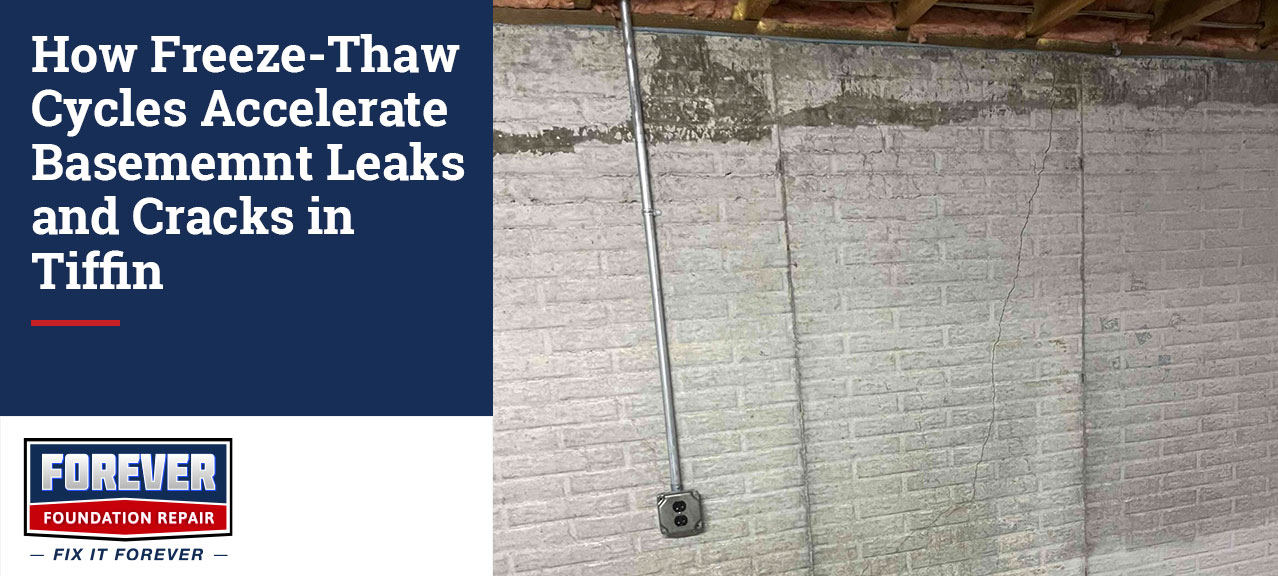
Every winter, Tiffin homeowners face a foundation threat that starts with basic physics: water expands by roughly 9% when it freezes. That expansion pushes against your foundation walls with tremendous force, turning hairline foundation cracks into real Tiffin basement leaks by spring. What makes Tiffin’s situation particularly challenging is the ground your home sits on. Blount-Pewamo clay soil in the Sandusky River Valley already holds significant moisture from heavy regional rainfall. When that saturated ground freezes and thaws repeatedly, the pressure building against your foundation walls intensifies well beyond what most homeowners expect.
This isn’t a problem that fixes itself between seasons. Each freeze-thaw cycle compounds the damage from the one before it, straining foundations already under stress from Seneca County’s wet soil conditions. This guide explains how that damage develops and what you can do to protect your home before winter arrives.
How Freeze-Thaw Cycles Damage Tiffin Foundations
Freeze-thaw foundation damage follows a sequence that repeats dozens of times each winter. Understanding the mechanics behind it helps you catch trouble early, well before basement cracks become a serious structural problem.
Why Water Expands Roughly 9% When It Freezes
Water expands by about 9% in volume the moment it turns to ice. At the molecular level, water molecules link through hydrogen bonds that force them into an open, hexagonal lattice as temperatures drop toward freezing, spacing those molecules further apart than they sit in liquid form. That lattice takes up more room than the water it came from — a basic fact of chemistry that drives nearly every form of frozen soil pressure your foundation experiences.
How Freezing Water Widens Existing Foundation Cracks
A hairline crack barely visible in October can grow clearly wide by spring. Moisture that works its way into a crack — or into the microscopic pores of concrete and masonry — freezes overnight and pushes outward with each cycle. Over one season, and certainly over several winters, those microfractures widen enough to let water pass straight through the wall, even when the surface still looks intact.
How Frost Heave Can Push Walls and Footings
Frost heave builds when freezing soil pulls groundwater upward into ice lenses — pressurized layers of ice that press against footings with forces exceeding 5,000 pounds per square foot. That water feeding the lens doesn’t need to sit directly beneath your home; it can migrate through soil from as far as 20 feet away. Because ice lenses form in pockets rather than evenly, the lifting isn’t uniform. One corner of a footing can rise while the rest of the structure stays put, straining every connected part above it.
Why Thawing Ground Can Settle Unevenly
Once temperatures climb back above freezing, the ground beneath your foundation doesn’t return to where it started. Soil shifts into the gaps left behind by moved footings and walls, leaving support that’s looser, weaker, or missing altogether in spots that once held firm. That uneven settling creates openings for groundwater to work deeper into your foundation — setting the stage for damage to compound with every winter that follows.
Footings set above the frost line take the worst of this pressure, since the ground beneath them absorbs the full swing of every freeze and thaw. That’s worth keeping in mind as you consider how Tiffin’s own soil composition feeds this cycle.
Why Tiffin’s Soil Can Make Winter Foundation Damage Worse
Soil composition determines how much winter punishment your foundation absorbs. Tiffin’s ground gives freeze-thaw cycles plenty to work with.
How Blount-Pewamo Clay Soils Retain Moisture
Blount-Pewamo soil holds water rather than releasing it. The series is classified as somewhat poorly drained, with a perched seasonal water table sitting as shallow as 15 to 61 centimeters below grade in normal years. Permeability through the clay-heavy subsoil runs slow to very slow. So instead of draining toward the Sandusky River, moisture lingers close to your footings all through fall and straight into the first hard freeze. Your foundation is already under pressure before winter officially starts.
How Sandusky River Valley Rain and Snowmelt Keep Soil Wet
Rain and melting snow raise the water level in the ground around your foundation, pushing against walls and floors long before temperatures drop. Clay holds that water longer than other soil types, keeping pressure elevated for days after a storm or a snowmelt event. Summer rain drains off relatively quickly. Melting snow is a different problem entirely — it saturates Tiffin’s clay-heavy ground for extended stretches, steadily raising the odds of water forcing its way through cracks or porous block walls.
How Frozen Soil Pressure Compounds an Already Stressed Foundation
Frost heave needs three conditions: a continual water source, temperatures cold enough to drive freezing deep underground, and soil fine enough to form ice lenses. Seneca County’s clay checks every box. Snowmelt frequently arrives while the ground below is still partially frozen, so drainage stalls and excess water pools directly against your foundation instead of moving away. When temperatures drop again, that standing water refreezes — widening cracks that moisture already worked into, and adding to the water pressure your walls were already carrying from a full season of saturated soil.
Signs Freeze-Thaw Damage Is Building in Your Basement
Your basement usually gives you warning before freeze-thaw damage turns into a serious structural problem. Knowing what to look for keeps repair costs manageable and keeps your family safe.
New or widening cracks after a hard freeze or thaw
Watch for cracks that appear or grow right after a hard freeze or a sudden thaw. According to the International Association of Certified Home Inspectors, foundation cracks worsen due to freeze-thaw cycles when left untreated. A hairline crack barely visible in October can become clearly visible by spring, since every freeze adds a bit more widening. Horizontal cracks deserve particular attention, since they form when freezing soil or water buildup pushes inward against the wall.
Seepage after snowmelt versus moisture from condensation
Seepage tied to snowmelt follows a recognizable pattern: water along the base of walls, damp carpet, or a sump pump running nonstop right after temperatures climb and accumulated snow starts melting. Condensation behaves differently. It shows up as droplets on cool surfaces during warm, humid stretches rather than after a freeze-thaw event. If water appears in your basement right after a snowmelt, that’s not condensation. That’s groundwater pushing through.
White deposits and peeling paint that suggest moisture movement
White, chalky efflorescence alongside peeling or bubbling paint confirms water has been moving through your foundation walls. Water pushing against your foundation from behind causes surface coatings to bubble and eventually flake. These aren’t cosmetic issues. They’re signals that moisture is already working its way through.
Bowed walls and sticking doors: when to seek a structural inspection
Bowing walls paired with doors or windows that suddenly stick point toward soil pressure bending the wall inward. That’s a condition that calls for prompt structural evaluation. Don’t wait on this one.
Why cracks can worsen over several winters, especially in older foundations
Clay-heavy lots like those common across Tiffin tend to produce wider cracks after winter compared to sandy soil, along with recurring cracks in the same spots year after year. An older foundation that’s already been through several Seneca County winters is carrying more accumulated damage than it shows on the surface.
Related warning signs
For a broader look at settlement indicators beyond winter conditions, review Signs of Foundation Settlement in Tiffin.
How to Protect Your Tiffin Basement Before Winter
The good news is that freeze-thaw foundation damage in Tiffin is largely preventable when you address the right conditions before the first hard freeze hits Seneca County.
Clear Gutters and Improve Grading to Reduce Soil Saturation
Water flowing toward your foundation instead of away from it is the first problem to fix. Slope your yard away from the house, clean gutters regularly, and extend downspouts at least 6 feet from the foundation. Less water sitting near your footings means less moisture available to freeze and push against your walls when temperatures drop.
Use Interior Drainage and Sump Pumps to Manage Incoming Groundwater
An interior drainage system captures groundwater at the floor-wall joint before it spreads across your basement floor, then routes it to a sump pump for ejection outside. This approach relieves water pressure against your walls directly, rather than letting it build all winter long.
Keep Discharge Flowing with Freeze Relief Sump Pump Discharge
A sump pump that can’t discharge is no help at all. Discharge lines that freeze in winter are a common cause of pump failure, so bury lines below the frost line and insulate exposed sections with heat tape. Forever Foundation Repair’s Freeze Relief Sump Pump Discharge keeps water moving away from your foundation even through Seneca County’s hardest freezes.
Seal Suitable Cracks Before Winter Arrives
Cracks under 1/4 inch that are vertical and stable are good candidates for sealing before winter; wider or horizontal cracks need professional evaluation first. Sealing the right cracks at the right time cuts off the moisture entry points that freeze-thaw cycles depend on to do their damage.
Match Drainage Repairs to Your Waterproofing Needs
Drainage fixes work best when they’re paired with grading corrections tailored to your specific soil conditions. A full waterproofing plan accounts for both, giving your foundation protection that holds up season after season.
Schedule a Pre-Winter Assessment with Forever Foundation Repair in Tiffin
Have your foundation and drainage inspected before the first hard freeze arrives in Seneca County. Contact us today for a no obligation, custom inspection and repair quote—and get ahead of the conditions that drive freeze-thaw damage before winter makes them worse.
Conclusion
Saturated Blount-Pewamo clay, water pushing against your foundation, and the relentless cycle of freezing and thawing — these are the conditions Tiffin homeowners deal with every winter. Small cracks don’t stay small when that cycle repeats season after season without intervention.
The good news is that grading corrections, interior drainage, freeze relief sump pump discharge, and timely crack sealing can stop that damage before it compounds. Forever Foundation Repair has spent years protecting Seneca County homes from exactly these conditions. Contact us today for a no obligation, custom inspection and repair quote — and get your Tiffin foundation checked before the first hard freeze arrives.