
Forever Foundation Repair has spent 15 years solving foundation problems specific to Northwest Ohio, and Sandusky homes present some of the most demanding conditions we see across our entire service area. Shoreline properties deal with elevated humidity and groundwater pressure that most inland homes never face. Clay-heavy soils throughout Erie County, combined with frequent freeze-thaw cycles driven by Lake Erie’s weather patterns, put your home at real risk of water intrusion and structural issues. Seasonal moisture changes and soil movement can stress your foundation over time.
Sandusky Ohio basement waterproofing requires a different approach than typical inland repairs. Coastal moisture basement problems, elevated water table conditions common to lake homes, and Erie County clay soil foundation issues all call for region-specific foundation repair Sandusky OH solutions. Forever Foundation Repair understands that difference — and builds every fix around what your home actually faces near the water.
Quick Answer: How Lake Erie Affects Sandusky Foundations
Your foundation’s exposure to Lake Erie moisture depends on more than just how far your home sits from the water line. Groundwater behavior, soil type, and seasonal lake patterns all combine to shape the risk your property faces. Understanding each piece gives you a clearer picture of what’s happening beneath your basement floor.
Why lake proximity can influence local groundwater and humidity
Homes closer to the shoreline sit near a steady water source that keeps surrounding soil wetter than anything found further inland. Sandusky Bay, sheltered behind the Cedar Point peninsula, often holds different conditions than the open lake just outside it — so your exact spot along the shoreline matters as much as the general coastal setting. That Sandusky Bay proximity raises the baseline saturation of soil around your home, feeding the elevated water table conditions lake homes experience and driving coastal moisture basement problems rarely seen on inland Erie County properties.
Elevated water table vs. seasonal rainfall: steady pressure or short-term spikes?
A high water table forms when the saturated zone beneath your yard rises close to your foundation’s depth. That works differently than rainfall-driven surface runoff. Groundwater moves slowly and responds to cumulative moisture rather than a single storm, so water pushing against your basement walls can stay elevated for weeks even after the yard looks completely dry. Lake Erie’s own water levels follow a comparable seasonal pattern, generally rising each spring and summer from snowmelt runoff before dropping through fall. Your foundation can face steady lake-influenced pressure on top of short-term spikes from Northern Ohio precipitation events — a double layer inland homes simply don’t deal with.
How Erie County clay soil, rainfall, and freeze-thaw cycles add stress
Clay soil holds water far longer than sandy soil, and once saturated, it loses strength and shifts under load. Freeze-thaw cycles make this worse. Frozen ground blocks drainage until a thaw releases built-up moisture straight into already damp clay. That repeated cycle wears down Erie County clay soil foundation stability in ways drier inland soil never would.
Why shoreline distance, ground height, and drainage change each home’s risk
No two Sandusky homes face identical exposure. Distance from the shoreline, foundation elevation relative to grade, and drainage quality each shift the risk. A structure raised above the seasonal high water table sees lower exposure. A low-lying lot with poor grading sits right in that saturated zone — regardless of how far it sits from the bay.
How Coastal Moisture Shows Up in Sandusky Basements
Coastal moisture doesn’t always announce itself with a flood. Smaller signals build over time, and knowing what to look for helps you catch Lake Erie moisture and foundation problems in Sandusky before they turn into structural repairs.
Basement humidity that stays high between storms
Basement air near the shoreline often stays damp even when skies clear. Groundwater and soil moisture keep evaporating into the space long after rain stops, so the humidity never fully drops. Relative humidity above roughly 50% creates conditions where mold begins growing within 24 to 48 hours. Lake Erie humidity foundation damage builds this way — through air that never fully dries, not through a single flood event.
Sump pumps that run often during dry weather
A pump cycling during heavy rain, spring thaw, or high water table periods is doing exactly what it should. A pump running nonstop with no rain for days, though, points to something else — a high water table, an underground spring, or a failed check valve feeding water back into the pit. Elevated water table lake homes often see that dry-weather cycling as a sign of ongoing hydrostatic pressure, not a simple mechanical fault.
Damp walls and efflorescence that keep returning
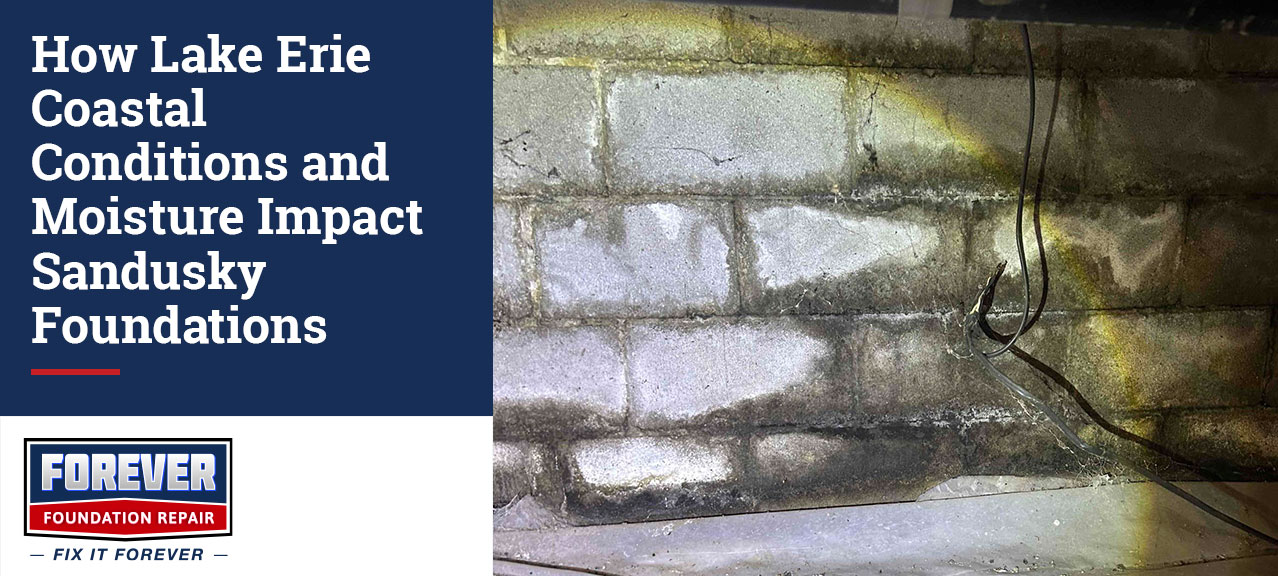
Efflorescence forms when water moves through masonry, dissolves salts, and deposits them on the surface as it evaporates. Deposits returning within days of cleaning usually mean water is pushing through your walls continuously. Erie County clay soil holds moisture longer than sandier soil, so this cycle stays active longer than most inland homeowners ever deal with.
Musty odors and mold linked to lasting moisture
A musty smell almost always means moisture is entering or lingering — even without visible water. Mold produces the volatile compounds behind that odor, and the smell alone is reason enough to take a closer look. Lake humidity basement mold risk grows the longer that moisture source goes unaddressed.
Cracks, bowing walls, and uneven floors that need structural checks
Horizontal cracks, inward wall movement, and floors sloping toward one side signal lateral soil pressure, not normal settling. Cracks wider than a quarter inch and stair-step patterns in block or brick warrant professional evaluation. These signs paired with coastal moisture basement problems call for foundation repair Sandusky OH solutions — not cosmetic fixes.
Protecting Sandusky Homes From Coastal Moisture
Protecting your Sandusky home starts at the roofline and works down to the soil. Gutters, downspouts, and proper grading form the first line of defense against coastal moisture basement problems. A single one-inch rainstorm can push hundreds of gallons off an average roof straight into the soil beside your foundation. Downspouts need to carry that water at least 5 feet from your home — or to a catchment system 10 feet out — because Erie County clay soil swells when saturated and can crack or lift foundation materials once water pools beside your footing.
Interior drainage and sump pumps near Sandusky Bay need to handle ongoing groundwater loads, not just occasional storm runoff. Building code requires a sump at least 24 inches in diameter, extending 24 inches below the basement floor, with positive drainage to daylight or an approved sewer. A battery backup pump matters here too, since power outages during storms hit exactly when groundwater pressure against your foundation peaks.
Crawl spaces need ground moisture control, not just ventilation. Vented crawl spaces in humid coastal climates often trap more moisture than they release, letting it condense on floor framing and feed fungal growth and wood damage. Capillary action carries groundwater vapor straight through porous materials regardless of airflow.
Crawl space encapsulation in Sandusky solves this directly. Sealing and conditioning your crawl space delivers energy savings, comfort, moisture control, and better air quality — the same results basement waterproofing already brings to homes throughout Erie County.
When saturated clay has already shifted your structure, foundation repair in Sandusky, OH may call for helical piers rather than drainage fixes alone. Piers reach stable soil depth where moisture swings no longer affect support — a solution built to hold for the long term.
Forever Foundation Repair: Assessments and Common Questions
Every property near Sandusky Bay tells a different story. Forever Foundation Repair evaluates groundwater signs, drainage, soil composition, and structural movement before recommending any fix for Lake Erie moisture and foundation problems in Sandusky — because guesswork doesn’t hold up against Erie County clay soil.
Schedule an assessment of groundwater signs, drainage, soil, and structural movement
A proper assessment looks at sump pump cycling patterns, grading and downspout placement, soil composition near the footing, and any cracking or wall movement together. These factors work against your foundation as a system, not separately. Contact us today for a no obligation, custom inspection and repair quote.
Does living near Lake Erie really affect my foundation?
Yes. Shoreline proximity raises soil saturation and humidity well beyond what inland Erie County properties experience, feeding ongoing coastal moisture basement problems that don’t dry out between storms.
How does lake-related groundwater differ from normal Ohio rainfall?
Lake Erie holds roughly a 2.6-year retention time, meaning Sandusky Bay water table conditions shift gradually and stay elevated for weeks. Northern Ohio precipitation events create short, sharp surges that drain off faster — your foundation near the coast deals with both at once.
Do all Sandusky homes face the same coastal moisture risk?
No. Elevation, distance from the shoreline, and drainage quality each change exposure significantly. Two neighboring homes can show very different symptoms depending on lot grade and soil depth alone.
Are crawl spaces more vulnerable than basements, or does depth matter?
Both face real risk. Basements fight water pushing against walls, while crawl spaces face constant ground evaporation through exposed earth. Clay beneath either structure can draw moisture upward 12 to 20 feet through capillary action — depth alone doesn’t determine vulnerability.
What combination of drainage, sump pumps, and moisture control fits my home?
That depends on what your soil and groundwater actually show. Forever Foundation Repair matches exterior grading, sump capacity, and crawl space encapsulation Sandusky solutions to your home’s specific conditions — not a one-size-fits-all package.
Conclusion
Shoreline proximity, Erie County clay soil, and hydrostatic pressure don’t work in isolation — they work together against your foundation, and generic fixes rarely hold up against what Sandusky Bay water table conditions can deliver. Your home’s exposure is specific to where it sits, how it drains, and what the soil beneath it holds.
Forever Foundation Repair is the #1 trusted company for foundation repair in Ohio and northeast Indiana, and we know Sandusky’s coastal conditions as well as any team in the region. Contact us today for a no obligation, custom inspection and repair quote.