
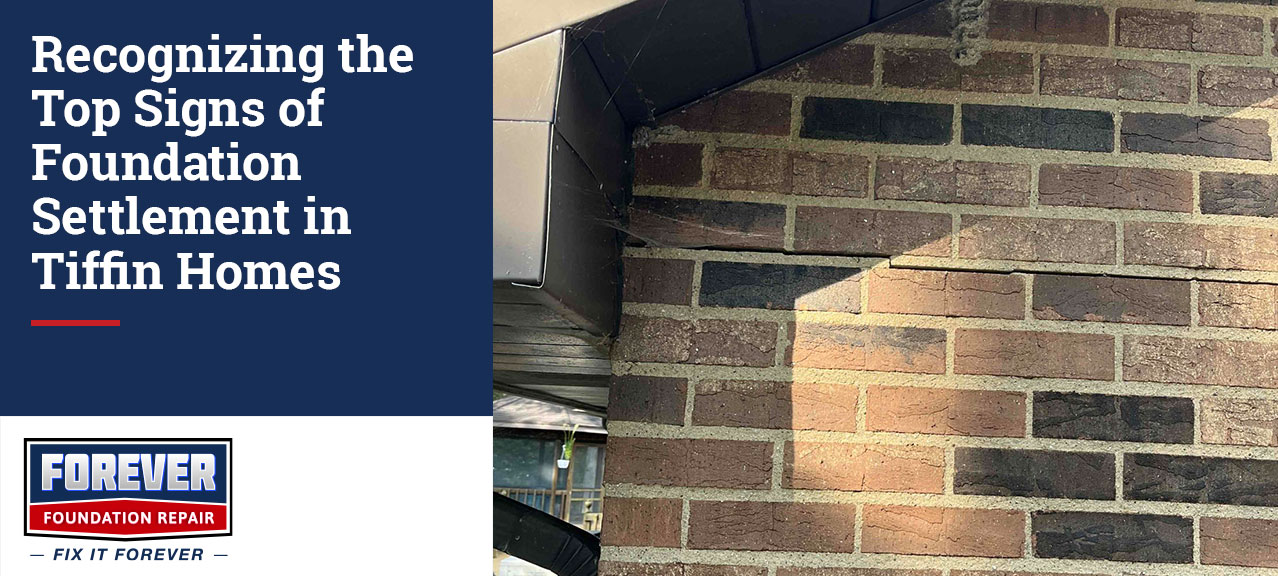
Forever Foundation Repair is the #1 trusted name for foundation repair in Tiffin OH, and our team knows firsthand how Seneca County homes develop problems. Signs of foundation settlement Tiffin Ohio homeowners notice often start small — a door that sticks, stair-step cracks creeping across brick mortar joints, or a floor that no longer feels level. Left unaddressed, these changes grow as the soil beneath your home shifts, compresses, or loses support.
Tiffin sits in the Sandusky River Valley atop Blount-Pewamo clay soil, a condition that leaves Seneca County homes especially vulnerable to seasonal saturation and differential settlement. Our specialty is tackling the unique problems that come with this region’s wet climate and clay-heavy soil composition. Sticking doors, sloping floors, and gaps around window and door frames are warning signs worth watching closely — and catching them early is the difference between a manageable repair and a costly one. Forever Foundation Repair helps you recognize these signs and guides you toward lasting foundation repair in Tiffin OH before small issues grow into bigger structural problems.
Quick Answer: Six Signs of Possible Foundation Settlement in Tiffin
Not every crack or sticking door means your foundation is in trouble, but a pattern of changes tells a different story. Here are six signs of foundation settlement Tiffin Ohio homeowners should watch for — each tied to how Blount-Pewamo soil behaves beneath a home.
1. Gaps around window and door frames: caulk wear or changing alignment?
A small gap around a window or door, roughly 1/16 inch or less, is often cosmetic if it stays the same size. Settlement produces a different pattern: wedge-shaped gaps wide at one corner and tight at the other, often clustering on one side of the house. If caulking doesn’t stop a gap from reopening within a season, the frame is still moving — and that movement needs a closer look.
2. A separating chimney or porch: movement at separate footings
Chimneys and porches typically rest on separate footings from the main foundation. Blount-Pewamo clay doesn’t compress evenly across a property, so these structures can settle at a different rate than the house, pulling away and leaving a visible gap at the seam. A gap that widens over time is not a cosmetic issue.
3. Stair-step cracks in brick or block: movement along mortar joints
Diagonal cracks running at 30 to 75 degrees from a corner or opening are the signature of differential settlement. In brick or block walls, this pattern follows the mortar joints in a stepped line — a formation known as stair-step cracking in brick foundation walls. The crack typically widens at the upper end, showing one section of the wall dropping while the rest holds steady.
4. Sticking doors and windows: humidity or shifting openings?
Humidity swelling wood is the most common — and most harmless — reason a door drags. The EPA recommends keeping indoor humidity between 30 and 60 percent to limit this. Sticking tied to foundation settlement behaves differently: it shows up in multiple openings at once, doesn’t ease with the seasons, and often binds at the top or side of the frame rather than the bottom.
5. Sloping or uneven floors: simple checks and their limits
A level placed across a room, or a marble rolled along the floor, can reveal a slope worth noting. These checks confirm a floor isn’t level, but they can’t show how much the foundation has moved or where support has failed. That’s why a professional foundation inspection relies on more precise tools like a Zip Level to pinpoint the problem.
6. Horizontal or diagonal wall cracks: sideways pressure versus settlement
Vertical cracks usually fall into the monitor-and-seal category. Horizontal cracks are flagged as high-risk in 90 percent of structural evaluations because they point to lateral soil or water pressure against the wall. A bowing basement wall in Tiffin, or any wall displacement exceeding 1/2 inch, calls for prompt evaluation — not a wait-and-see approach.
Why Soil and Water Conditions Matter in Tiffin
Soil behavior explains why signs of foundation settlement Tiffin Ohio properties show up in the first place. The ground beneath your home isn’t a passive surface — it reacts to rain, drought, and the weight of your house, and in Seneca County, those reactions are more pronounced than most homeowners expect.
Blount-Pewamo clay soils: confirm conditions at your property
Tiffin sits on Blount-Pewamo soil, a dense clay series with subsurface horizons holding 35 to 48 percent clay content. Blount soils are somewhat poorly drained, formed in glacial till, and carry a perched seasonal water table that sits between 0.5 and 2 feet below the surface in a typical year. Pewamo soils — found in low-lying areas and drainageways nearby — are classified as very poorly drained, meaning parts of a Seneca County clay soil lot hold standing water well after surrounding areas dry out. Every lot carries a different mix of these soils, which is why confirming conditions at your specific property matters more than assuming a uniform soil profile across the neighborhood.
Seasonal saturation and drainage in the Sandusky River Valley
Mean annual precipitation across the Blount series range runs from 29 to 42 inches. Clay particles pack tightly, slow drainage, and hold moisture against your foundation longer than sandy or loam soils would. Permeability is already slow through the upper soil layers, and it drops to very slow once water reaches the dense till beneath. Summer heat dries the clay out, causing it to shrink and pull away from your foundation. Spring rains wet it back up, and it expands again — a wet-dry cycle Sandusky River Valley homes deal with every single year.
How uneven soil support causes differential settlement
Differential settlement foundation damage happens when one section of your footing drops more than another. Rather than the whole house settling uniformly — which would be far less damaging — one corner drops while another holds, straining connections and fracturing walls, floors, and door frames. Variable clay thickness, pockets of fill soil, and drainage differences across a single lot all contribute to this uneven support. That’s exactly what produces the stair-step cracks, sloping floors, and sticking doors described above.
When Should You Schedule a Foundation Inspection?
A single changing sign doesn’t always mean your foundation needs repair, but a pattern of related signs changes the picture entirely. Knowing when to call for a foundation inspection Seneca County homeowners can trust comes down to watching how signs develop together, not in isolation.
One changing sign can warrant attention; several related signs strengthen the concern
Cracks widening over time, one side of a crack sitting higher than the other, or several symptoms appearing at once — cracking paired with sticking doors and sloping floors — are clear reasons to call. A single hairline crack that hasn’t changed in months carries far less concern than new cracks showing up alongside gaps around window and door frames or a chimney pulling away from the house.
Rapid movement, leaning masonry, or bowing walls need prompt evaluation
Horizontal cracks, visible wall leaning, or a bowing basement wall in Tiffin point toward active lateral pressure — not ordinary settling — and these need prompt review rather than continued monitoring. A crack wider than 1/16 of an inch, especially when several appear together, warrants a professional look rather than a wait-and-see approach.
Record dated photos, recurring damage, and wet or dry weather
Photograph cracks from the same angle, note the width, and recheck after heavy rain or a long dry spell. Seneca County’s clay soil causes some cracks to widen in wet months and narrow during dry ones. Repairs that keep reopening, new cracks forming near older ones, or damage returning after each wet-dry cycle suggest the underlying cause hasn’t been addressed.
What to ask Forever Foundation Repair during a Seneca County assessment
During your assessment, ask what’s causing the movement, not just what the repair costs. A reliable answer should identify the soil, drainage, or structural factor behind the damage. Ask how drainage and grading get evaluated alongside the foundation — water problems and foundation problems in this area almost always share the same root cause.
How Foundation Settlement Is Repaired in Tiffin
Foundation repair Tiffin OH starts with understanding how Blount-Pewamo soil and groundwater behave at each specific property. There’s no single fix for every home — the right solution depends on what’s happening beneath your foundation.
Helical piers: support below weak soil, with depth based on site conditions
Helical pier foundation repair Tiffin homeowners rely on uses galvanized steel shafts with welded plates, mechanically screwed into the ground until torque readings confirm stable bearing soil. Residential installations typically reach 15 to 40 feet, pushing past the active clay zone where seasonal shifting causes the most damage. Depth depends on site conditions — two homes on the same street can require different pier lengths based on what’s directly beneath each footing.
Carbon fiber wall stabilization: a separate option for suitable bowing walls
A bowing basement wall in Tiffin showing less than 2 inches of inward deflection is often a strong candidate for carbon fiber wall stabilization rather than piers. Straps bond from footing to sill plate, stopping further movement from progressing. Walls bowed beyond that threshold usually call for a different repair approach.
Drainage correction and follow-up checks: support long-term repair performance
Water pushing against your foundation drives much of this damage, so correcting grading and drainage addresses the source feeding both settlement and wall bowing. Follow-up checks after piers or straps are installed confirm the repair holds through each wet-dry cycle that Seneca County clay soil delivers year after year.
Conclusion
Stair-step cracks, sticking doors, sloping floors, and bowing walls each tell part of the same story — Blount-Pewamo clay soil shifting, saturating, and pulling support away from your home’s foundation. Catching these signs of foundation settlement Tiffin Ohio homeowners experience early is what separates a straightforward repair from a costly structural problem.
Understanding Seneca County clay soil behavior, seasonal saturation patterns, and how differential settlement develops gives you a clearer picture of what’s happening beneath your home. Forever Foundation Repair offers foundation inspection services built around Tiffin’s specific soil and drainage conditions, ensuring your home stays safe, dry, and structurally sound for your family.
Contact us today for a no obligation, custom inspection and repair quote.