
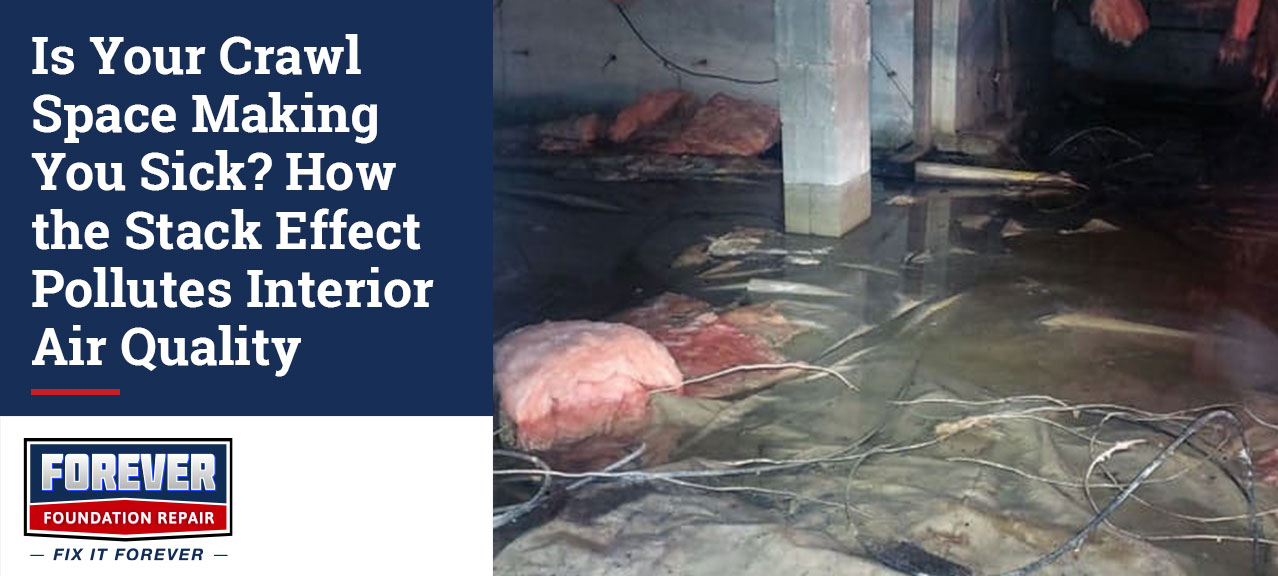
Homeowners across Northwest Ohio and Northeast Indiana deal with chronic allergies, musty odors, and persistent respiratory problems—and most never think to look beneath their feet. Up to 50% of the air circulating through your main floor comes directly from your crawl space. Unsealed, humid crawl spaces pull mold spores, dust mites, radon, and pest waste upward through your floorboards and straight into your bedrooms and living areas. That’s the stack effect at work, and it runs 24 hours a day.
At Forever Foundation Repair, our specialty is tackling the unique crawl space problems that come with Northwest Ohio’s wet climate and soil conditions. Crawl space encapsulation seals out moisture, mold, and soil gasses—keeping your family safe and your home’s air clean year-round.
The Science Behind the Pollution: Understanding the Stack Effect
What Is the Stack Effect?
The stack effect is straightforward: warm air rises, cold air sinks, and your home sits in the middle of that exchange. When your furnace heats interior air, those air molecules spread apart, become lighter, and float upward toward your ceiling, attic vents, recessed lights, and any unsealed gaps near the roofline. That rising air has to be replaced. Your home pulls in replacement air from the lowest accessible points—foundation cracks, rim joist gaps, and your crawl space. The result is a steady, continuous flow of outside air entering from below and pushing upward through your living space.
How the Stack Effect Creates a Vacuuming Action
Think of your home as a chimney. Warm air escapes at the top, and your crawl space sits directly at the intake point at the bottom. Foundation vents, utility penetrations around pipes and wiring, and subfloor framing gaps all provide open pathways for that incoming air. The framing above your crawl space is rarely airtight—air moves freely through openings around ductwork, electrical boxes, plumbing risers, and subfloor seams. Research confirms that as much as 50% of the air you breathe on your main floor originates directly from the crawl space. Whatever is living and growing in that dark, damp space beneath your feet gets delivered straight into your breathing zone, continuously.
Why Winter and Summer Both Make It Worse
Temperature extremes intensify the pressure driving this cycle. Cold winter conditions generate approximately 4 pascals of pressure per story of building height, while summer heat produces about 1.5 pascals per story. Winter creates the strongest upward airflow—furnaces run hard, outdoor temperatures drop, and the pressure differential reaches its peak. This thermal stack effect can account for 40% of annual heating costs in typical homes.
Summer reverses the direction but doesn’t stop the problem. Hot attic air rises and escapes, and humid outdoor air gets pulled through your crawl space to replace the conditioned interior air pushed down by your air conditioning. Both seasons run the same vacuuming mechanism. What changes is the air quality coming in—cold and dry in winter, warm and moisture-heavy in summer.
What Is Getting Pulled Into Your Air from the Crawl Space?
Mold Spores and Fungal Growth
Relative humidity above 60% in a crawl space is all mold needs to take hold. Fungal colonies can develop within 24 to 48 hours after water exposure, spreading across floor joists, subflooring, and insulation. Once established, these colonies release microscopic spores directly into your ventilation system, triggering allergic reactions, respiratory irritation, and lung problems. Black mold, white mold, and green mold all thrive in dark, damp crawl spaces with poor airflow. Every colony beneath your feet sends contaminated air straight into your bedrooms and living areas, all day, every day.
Dust Mites and Allergen Byproducts
Dust mites don’t drink water—they absorb moisture from the air and need relative humidity above 60% to survive. Their droppings are the number one allergen for people with asthma and allergies. Dust mites don’t live in your crawl space, but when crawl space air raises humidity levels throughout your home, they thrive on every floor. Dry out your crawl space, and the dust mites upstairs dry out with it.
Radon and Volatile Organic Compounds
Exposed dirt or gravel floors let radon gas migrate freely from soil into your living space. Radon causes approximately 20,000 lung cancer deaths every year, making it the second leading cause of lung cancer in the United States. Once radon concentration reaches 4 picocuries per liter of air, your risk increases significantly. Beyond radon, volatile organic compounds from contaminated soil and buried wastes enter your home through foundation cracks and utility penetrations—often without any odor or visible sign.
Pest Droppings and Bacteria
Rodents, insects, and pests leave behind urine, droppings, and decomposing matter that break down into microscopic airborne particles. Rodent waste carries bacteria and viruses that cause serious illness when inhaled. Cockroach allergens are a well-documented trigger for asthma attacks, particularly in children.
Excessive Moisture and High Humidity
The EPA recommends keeping indoor relative humidity below 60% to reduce mold growth, wood rot, and pest activity. When humid crawl space air gets pulled into your main living level, it overworks your HVAC system and creates conditions for dust mites to breed throughout your entire home. The crawl space and your living space are connected—what happens below affects what you breathe above.
Recognizing the Signs: Is Your Home Affected?
Health and Allergy Indicators
Your body often signals crawl space trouble before you notice any visible damage. Persistent coughing, sneezing, or wheezing without seasonal triggers points directly to mold spore exposure. Sinus irritation, throat discomfort, and chronic headaches frequently accompany poor crawl space air quality. Children, seniors, and family members with compromised immune systems face the greatest risks from prolonged exposure. Recurring respiratory infections, unexplained fatigue, and skin rashes are all signs of airborne allergens circulating through your home. If multiple family members develop allergy symptoms at the same time indoors, moisture and biological contaminants in your crawl space are likely the cause.
Persistent Musty or Earthy Smells
That damp, musty odor you can’t seem to locate? It’s one of the most common early warning signs of crawl space moisture problems. Mold and mildew release volatile organic compounds as they break down organic materials, and the smell concentrates near floor registers, baseboards, and ground-level rooms where stack effect airflow is strongest. Some homeowners describe it as earthy or soil-like. Regardless, any persistent odor rising from below means active biological growth that needs immediate attention.
Buckling or Squeaking Hardwood Floors
Moisture working its way into your subfloor causes wood planks to swell and distort. At 75% relative humidity, hardwood floors begin cupping—board edges rising higher than their centers. Continued moisture absorption forces planks to buckle and lift off the subfloor entirely. Squeaking develops as swollen boards shift and compress against each other within the framing. Replacing damaged flooring without fixing the crawl space moisture problem guarantees the damage will come back.
Condensation on Windows or High Interior Humidity
Window condensation and elevated indoor humidity readings are signs that excessive moisture is being pulled upward from your crawl space. Relative humidity held above 60% for 72 hours is enough to trigger mold, mildew, and fungal growth throughout your living spaces.
Visible Mold Growth on Structural Timber
Black, green, or white discoloration on floor joists and subflooring means active fungal growth that requires professional remediation. Surface mold causes cosmetic staining, while decay fungi darken and shrink wood—directly compromising your home’s structural integrity. This is the point where a moisture problem becomes a structural one, and addressing it quickly protects both your family’s health and your home’s long-term safety.
How Forever Foundation Repair Fixes Your Crawl Space
Crawl space encapsulation is not a single-step fix. Our team works through a proven process that addresses drainage, moisture, airflow, and humidity together—because solving one without the others leaves the problem incomplete.
Step 1: Structural Repair and Drainage
Every encapsulation starts outside your home. Our technicians correct exterior drainage by grading soil away from your foundation at a 5% slope, extending downspouts at least 10 feet from the building, and redirecting sprinklers that direct water toward your foundation. Inside the crawl space, our crew removes debris and sharp objects that could puncture the liner, repairs any active plumbing leaks, and clears standing water. A clean, dry starting point is what makes everything else last.
Step 2: Complete Vapor Barrier Installation
A heavy-duty polyethylene barrier gets laid across the entire crawl space floor, with seams overlapping 6 to 12 inches and sealed with manufacturer-approved tape. The membrane runs 6 to 12 inches up foundation walls, secured with butyl tape and mechanical termination bars. Our technicians wrap and seal interior piers so moisture cannot wick upward into your framing, and carefully fit patches around plumbing, wiring, and duct penetrations. No gaps. No shortcuts.
Step 3: Sealing Vents and Penetrations
Once the vapor barrier is in place, all foundation vents receive airtight covers. Under International Residential Code Section 408.3, sealed crawl spaces no longer require ventilation openings when proper mechanical systems are installed. Sealing these entry points stops the stack effect’s intake cycle at the source.
Step 4: Specialized Dehumidification
Industrial-grade dehumidifiers sized to your crawl space square footage run continuously, plumbed directly to drain lines. This keeps relative humidity below 55% year-round—well under the threshold where mold, dust mites, and wood rot take hold.
Protect Your Family’s Health with a Sealed Crawl Space
A contaminated crawl space means contaminated air for your family—there’s no way around it. Mold, allergens, and toxic gasses travel from beneath your floors directly into your bedrooms and living areas every single day. Professional crawl space encapsulation stops that cycle at the source, keeping your home safe, dry, and structurally sound for years to come.
Forever Foundation Repair is the #1 trusted company for crawl space encapsulation in Ohio and northeast Indiana. Musty smells, allergy flare-ups, and moisture damage don’t have to be a permanent part of your home. Contact us today for a no obligation, custom inspection and repair quote.