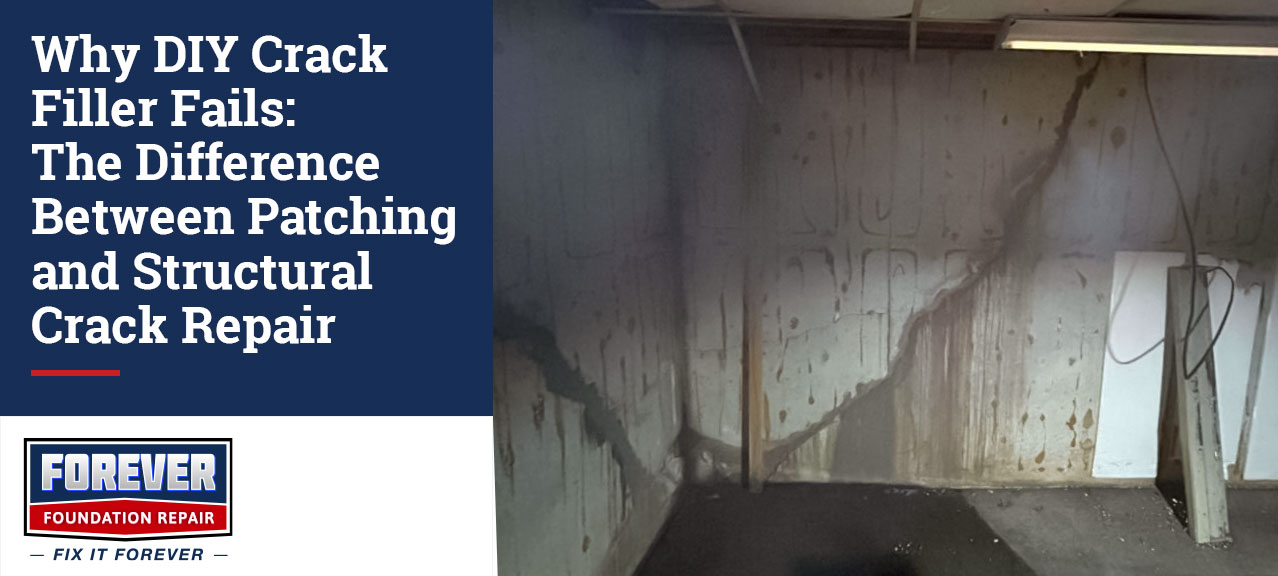
That $15 tube of crack filler from the hardware store looks like a simple solution. When homeowners attempt a DIY foundation crack repair with store-bought caulk or cement, they usually fill the gap and move on—until the crack returns, wider than before, and water starts finding its way into the basement.
The hard truth is that most over-the-counter products only mask the problem. They never address what is actually happening beneath the surface. Any crack wider than 1/4 inch (6mm) deserves immediate professional attention. In Northwest Ohio and Northeast Indiana—where heavy clay soils, seasonal rain, and severe freeze-thaw cycles put constant pressure on foundations—understanding structural crack repair vs patching can mean the difference between a simple permanent fix and tens of thousands of dollars in structural damage.
Knowing how to tell if a foundation crack is structural is critical knowledge for any homeowner in our region. Here is why hydraulic cement and caulk consistently fail, how professional repair methods work, and when your foundation needs more than a surface patch.
Why DIY Foundation Crack Filler Fails
Concrete Caulk and Silicone Fillers: Poor Bonding and Zero Elasticity
Standard acrylic and silicone caulks perform fine around door frames and windows. Foundation cracks are a different story entirely. A 20-foot poured concrete basement wall expands and contracts significantly across seasonal temperature shifts. Most caulks are only designed to stretch and compress about 25%, making them unable to keep up with the expansion and contraction caused by seasonal temperature changes.
The failure pattern is predictable:
- Adhesion Failure: Ground movement breaks the bond between the caulk and the porous concrete wall.
- Cohesion Failure: The material tears apart internally as soil pressure shifts the wall.
- Reapplication Obstacles: Silicone becomes brittle and will not bond to itself once cured, requiring complete manual removal before any new material can be applied.
Most caulk repairs fail within 6 to 12 months, allowing water right back into your basement.
Why Hydraulic Cement Fails on Foundation Cracks: Rigid, Brittle, and Surface-Level Only
Hydraulic cement carries an appealing reputation for quick fixes. However, why hydraulic cement fails on foundation cracks comes down to basic material engineering: it seals only the outer $1/2$ inch of the surface, leaving the interior core of the crack completely open.
Its fast-setting formula leaves zero working time for deep penetration. Once cured, hydraulic cement is completely rigid. As Midwest temperatures shift, the concrete wall moves, causing the brittle cement patch to snap, loosen, or pop out entirely. Hydraulic cement is a temporary band-aid—not a structural repair.
The Freeze-Thaw Factor in Northwest Ohio and Northeast Indiana
Water expands by 9% when it freezes. That single physical reality explains why surface patches fail so consistently across Northwest Ohio and Northeast Indiana.
During winter, moisture trapped in the soil surrounding your foundation freezes and expands, exerting immense lateral frost-heave pressure against foundation walls. Water trapped behind a thin DIY surface patch freezes, expands, and forces the crack wider. When spring thaws arrive, melted snow and high water tables push through those widened fractures under heavy hydrostatic pressure—turning a minor crack into a flooded basement.
Patching vs. Structural Crack Repair: Knowing the Difference
| Feature | Surface DIY Patching | Professional Structural Crack Repair |
| Material Used | Silicone, acrylic caulk, hydraulic cement | High-viscosity epoxy resin or expanding polyurethane |
| Penetration Depth | Surface level (1/8″ to 1/2″ deep) | Full wall thickness (entire 8″–10″ poured wall core) |
| Moisture Resistance | Poor (traps water behind the patch) | 100% waterproof barrier through the entire wall |
| Structural Integrity | Zero load-bearing strength added | Restores concrete back to original or higher tensile strength |
| Lifespan | 6 to 18 months | Permanent (Lifetime Transferable Warranty) |
What Surface Patching Actually Does (And Doesn’t Do)
Surface patching covers the crack you can see, but it does nothing about the structural stresses driving the crack deeper. Gravity-fed sealants and caulks rarely penetrate more than $1/4$ inch into a wall fracture. Patching is a reactive approach that leaves the root cause untreated.
What Professional Structural Crack Repair Involves
Professional repair fills the full depth of the wall. Using specialized port injection systems, technicians inject low-viscosity resin through the fracture, filling voids as narrow as 0.002 inches. This process bonds the severed concrete sections back into a solid, monolithic unit that is actually stronger than the original wall.
How to Tell if a Foundation Crack Is Structural
Non-Structural Shrinkage Cracks: Hairline Vertical Fractures
Not every crack signals structural failure. Roughly 85% of foundation cracks are non-structural shrinkage cracks caused as concrete cures during initial construction.
- Appearance: Hairline fractures less than 1/16 inch wide.
- Orientation: Vertical or within 30 degrees of vertical.
- Primary Concern: While non-structural, these cracks still allow water, radon gas, and soil pests to enter your living space.
Structural Settlement Cracks: Horizontal and Diagonal Warning Signs
- Horizontal Cracks: Signal heavy soil and hydrostatic pressure pushing basement walls inward. These are severe structural red flags.
- Diagonal Cracks: Indicate differential settlement, where one corner of the foundation is sinking faster than the rest. On block walls, this appears as stair-step cracking along mortar lines.
- Offset/Displacement: If you run your hand across a crack and one side sits further inward or higher than the other (vertical displacement exceeding 1/4 inch), the wall has lost its structural unity.
Permanent Concrete Crack Repair Methods Used by Professionals
Epoxy Injection Crack Repair: Restoring Structural Strength
For dry, poured concrete walls requiring structural restoration, professional epoxy injection crack repair is the industry standard. Technicians mount injection ports along the fracture, seal the surface, and inject high-tensile epoxy under low pressure (20 to 200 PSI).
The resin flows through the entire wall thickness, bonding to the concrete interior. Once cured, a structural epoxy injection crack repair achieves tensile strength exceeding 2,000 PSI—making the repaired joint stronger than the surrounding concrete itself.
[Interior Wall Face]
       │
       ▼  (Injection Port)
┌──────┴──────┐
│  ===Epoxy===│ ──► Penetrates full 8"-10" concrete core
└──────┬──────┘
       ▲
       │
[Exterior Wall Face]
Polyurethane Foam Injection for Leaking Basement Cracks
When dealing with actively leaking basement or crawl space walls, expanding polyurethane foam is the preferred choice. Upon contacting water inside the fracture, polyurethane expands up to 20 to 40 times its liquid volume, filling every microscopic void and curing into a dense, flexible rubber seal within minutes.
While polyurethane does not add load-bearing strength like an epoxy injection crack repair, its continuous flexibility allows it to accommodate natural concrete thermal expansion without breaking its waterproof seal. Applying polyurethane foam injection in crawl space or basement walls stops active water intrusion instantly.
Carbon Fiber Reinforcement for Bowing Walls
If soil pressure has caused a basement wall to bow or crack horizontally, crack filling alone is insufficient. Carbon fiber straps bonded to the interior wall with structural epoxy provide 10 times the tensile strength of steel, permanently locking the wall in place and preventing further inward movement.
Addressing Hydrostatic Pressure and Soil Load Issues
Injecting a crack seals the opening, but managing groundwater pressure prevents new cracks from forming nearby. Combining crack injection with interior drainage systems, sump pumps, or exterior waterproofing ensures hydrostatic pressure is relieved before it damages your foundation walls.
Frequently Asked Questions
Can you repair a foundation crack from the inside?
Yes. For most homeowners, interior low-pressure resin injection is the most practical and cost-effective choice. It creates a full-depth waterproof seal without requiring expensive exterior excavation, landscape destruction, or weather delays.
Will homeowners insurance cover DIY foundation crack repairs that fail?
Generally, no. Most standard homeowners insurance policies explicitly exclude coverage for foundation damage caused by settling, hydrostatic pressure, earth movement, or wear and tear. Furthermore, if a failed DIY foundation crack repair leads to secondary water damage, insurance adjusters may deny the claim due to improper maintenance or non-professional workmanship.
Is epoxy injection better than polyurethane for basement cracks?
It depends on the crack’s condition:
- Epoxy Injection: Best for dry, structural cracks where welding concrete together is required.
- Polyurethane Injection: Best for active leaks, wet concrete, or non-structural cracks where high flexibility is needed.
For comprehensive basement wall crack repair in Northwest Ohio, technicians evaluate wall moisture levels and load conditions before selecting the appropriate resin.
Foundation Crack Severity & Repair Guide
| Crack Type | Severity Level | Recommended Repair Method |
| Hairline Vertical (<1/16") | Low (Non-Structural) | Polyurethane foam injection to seal against water/radon |
| Wide Vertical (>1/4″) | Moderate to High | Structural epoxy injection crack repair |
| Horizontal Cracks | High (Soil Pressure) | Carbon fiber reinforcement + structural crack injection |
| Stair-Step / Diagonal | High (Settlement) | Steel pier underpinning + structural crack repair |
Don’t Cover Up Structural Warning Signs
Surface patching hides the symptom; professional epoxy injection crack repair eliminates the problem. That distinction matters—before a $15 hardware store tub of cement leads to major structural failure.
If you notice horizontal cracks, diagonal fractures, or vertical displacement on your basement walls, skip the temporary surface patches. Forever Foundation Repair has provided engineered, permanent concrete crack repair methods for homeowners across Northwest Ohio and Northeast Indiana for over 15 years.
Don’t risk your home’s structural integrity on a DIY foundation crack repair. Contact Forever Foundation Repair today for a no-obligation, custom foundation inspection and repair quote!