Stair-step cracks in your drywall, doors that stick out of nowhere, floors that no longer sit level—these are not just cosmetic problems. These are structural red flags warning you that your foundation is settling. For homeowners across Northwest Ohio and Northeast Indiana, shifting soils and seasonal groundwater fluctuations make this a very real concern.
Steel piering is the industry gold standard fix. By transferring your home’s load off weak, unstable topsoil down to solid bedrock or load-bearing strata, steel piers stop settlement permanently and restore structural stability. Two primary systems lead the industry: push piers and helical piers. Both systems lift and stabilize settling structures, but they operate under completely different engineering principles and are designed for different soil and structural conditions.
Choosing between helical piers vs push piers comes down to your home’s total weight, your regional soil profile, and your existing foundation type. Get the right match and you protect your family’s most valuable investment for generations. Get the wrong match and you risk a foundation repair that fails to deliver the structural support your home actually requires.
Here is everything you need to know.
Understanding Push Piers: Heavy-Duty Foundation Repair
What Are Push Piers?
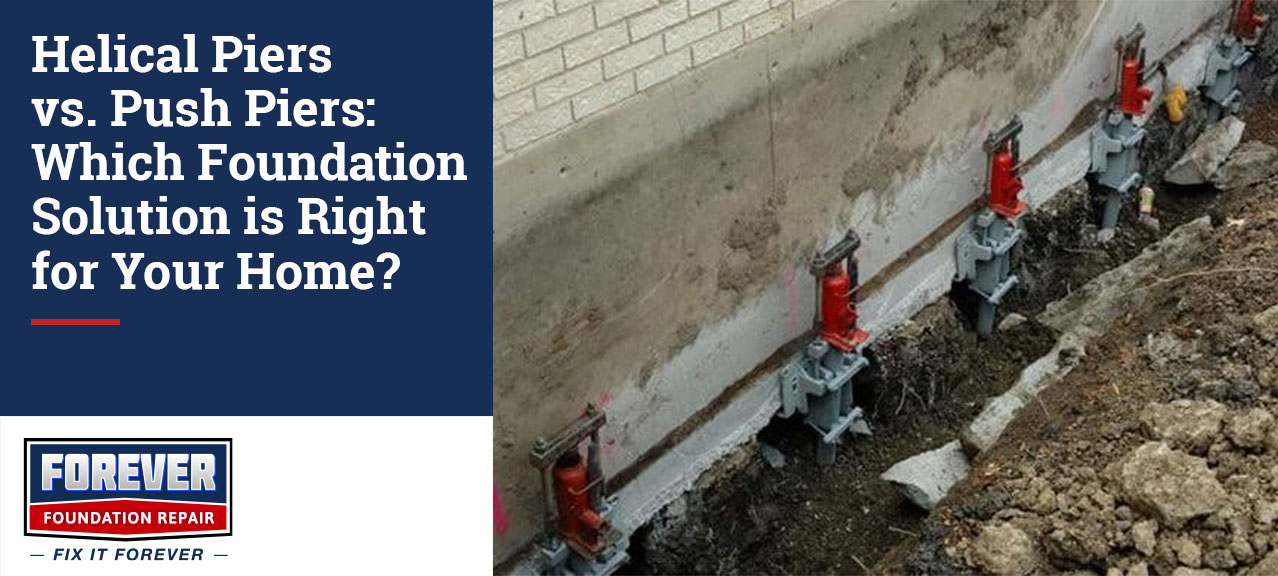
Push piers (also known as resistance piers) are galvanized steel tubes hydraulically driven beneath your foundation to transfer structural weight away from unstable surface soil down to solid bedrock or high-density load-bearing strata. Each pipe segment typically measures 3.5 feet in length, with outer diameters ranging from 2-7/8″ to 4.5″. The heavy-duty galvanized coating resists severe corrosion—an essential requirement given the seasonal moisture conditions common in Northwest Ohio clay soils.
[Foundation Footing Bracket]
│
▼
[3.5′ Galvanized Steel Section]
│
▼
[3.5′ Galvanized Steel Section] ──► (Compression-Fit Coupling)
│
▼
[Bedrock / Dense Strata]
How Do Push Piers Work?
Push pier installation relies on your home’s dead load weight as the counterweight driving force. Specialized hydraulic rams generate between 4,000 and 6,000 psi, driving smooth steel sections vertically down through unstable topsoil layers. Each segment locks securely into the next via a compression-fit coupling, allowing installation teams to add sections continuously until reaching impenetrable bedrock or refusal depth. Depths range from 10 feet to over 150 feet depending on subterranean geology.
Once the piers reach competent bearing strata, heavy-duty steel brackets attached beneath your foundation footing lock into place—transferring your home’s structural weight directly onto the pier system and bypassing compromised topsoil entirely.
When to Use Push Piers for Foundation Settlement
Push piers are engineered specifically for high-mass structures. Multi-story homes, full brick exteriors, heavy concrete block basements, and commercial structures with substantial weight are ideal candidates. The system excels when solid bedrock sits within reachable depths beneath the property. With ultimate load capacities reaching up to 68,000 pounds per pier, push piers deliver maximum load bearing where weight demands are highest.
Limitations of Push Piers
Push piers are not a universal fix:
- Lightweight Structures: Homes lacking sufficient mass (such as single-story wood frame builds or sunrooms) can lift prematurely at around 2,500 psi before the piers reach required load depth.
- Damaged Footings: Cracked or compromised foundation footings must be structurally repaired first, as brackets require solid, continuous concrete contact.
- Vertical Only: Compression-fit push piers cannot be installed at angles for lateral wall stabilization or tieback applications.
Understanding Helical Piers: Versatile Foundation Underpinning Solutions
What Are Helical Piers?
Helical piers (also called helical anchors or screw piles) are high-strength steel shafts with helically-shaped bearing plates welded along their length. Think of them as industrial-sized screws: the helical plates act like threads on a wood screw, advancing the steel shaft deeper into the earth with each rotation. These foundation underpinning solutions come in both residential-grade and commercial-grade capacities, engineered with specific shaft diameters and helix plate configurations to match your home’s structural requirements.
[Hydraulic Drive Head (Torque Motor)]
│
▼
[Solid Steel Shaft]
│
▼
[Helical Bearing Plate 1] ──► (Screws into soil)
│
▼
[Helical Bearing Plate 2]
How Do Helical Piers Work?
A hydraulic drive head rotates the steel shaft into the earth while continuously measuring installation torque. Installation torque correlates directly to load-bearing capacity: when the required torque rating is achieved, it verifies in real time that the helical plates are embedded into dense, load-bearing soil capable of supporting the structure. Unlike push piers, zero building weight is required to drive helical piers into the ground.
Best Applications for Helical Pier Foundation Repair
Helical piers handle both new construction supports and retrofits for existing homes. They excel for lightweight or medium-weight structures—porches, decks, sunrooms, manufactured homes, and single-story additions that lack the mass required for resistance-driven push piers. Beyond residential floor framing, helical piers are ideal for stabilizing retaining walls, basement walls, and commercial structures. Furthermore, choosing a dedicated helical pier foundation repair approach allows piers to be installed at precise angles for lateral soil tiebacks—a versatility push piers cannot match.
Helical Pier Installation in Clay Soil
Northwest Ohio and Northeast Indiana clay soils expand during wet springs and shrink during dry summer droughts. This constant movement in the active soil zone creates severe foundation settlement. Helical pier installation in clay soil bypasses this volatile top layer completely, turning through the active zone until the helical plates lock into stable, undisturbed subsoil layers below. With an engineered service life ranging from 75 to 350 years depending on soil corrosivity, helical piers deliver permanent structural stability.
Head-to-Head Comparison: Helical Piers vs Push Piers
Installation Method: Weight-Driven vs. Torque-Driven
Push piers use your home’s dead weight as resistance to force steel pipes downward. Helical piers use an independent hydraulic torque motor to screw the anchors deep into the ground without applying upward mechanical force to your foundation during installation.
Structure Weight Requirements
Push piers require a minimum of 3,500 to 5,000 pounds of structural weight per pier location. Smaller structures under 1,200 square feet often lack the required mass. Helical piers require zero structural weight during installation, making them universally adaptable.
Soil Condition Suitability
Push piers perform best where shallow, competent bedrock or high-density strata sits within 15 to 30 feet of the surface. Helical piers hold better alignment in soft, saturated soils and cohesive clay layers, though rocky soils with heavy cobble can deflect helical plates during rotation.
Foundation Piering Systems for Northwest Ohio & Northeast Indiana
Regional geology varies dramatically from town to town. Expansive clay soils around Toledo and Defiance demand deep anchoring below seasonal moisture lines, making helical piers an outstanding choice. Conversely, areas in Northwest Ohio with accessible bedrock closer to the surface allow push piers to achieve high-capacity end bearing. Selecting the right system requires a professional, site-specific subterranean assessment rather than guesswork.
Frequently Asked Questions
Are helical piers cheaper than push piers?
Not necessarily. While helical piers carry a slightly higher material cost per foot due to the specialized helical plates, they often reach verified load capacities at shallower depths than push piers driven to deep bedrock. This faster, shallower installation frequently results in a lower total project cost overall.
Can you install foundation piers in frozen winter ground?
Yes. Both helical and push piers can be installed year-round. Helical piers cut through frozen surface soil using high-torque installation motors without needing to wait for a spring thaw. In extreme frost conditions, pre-drilling the top layer ensures fast, efficient installation through the cold months.
How long do steel foundation piers last?
Galvanized steel foundation piers last well over 150 years under standard soil conditions. Depending on soil pH and corrosivity, structural service life ranges from 75 to 350 years, making steel piering a permanent, lifetime-warranted repair.
Helical Piers vs Push Piers: Side-by-Side Comparison
| Feature | Push Piers (Resistance) | Helical Piers (Screw-In) |
| Primary Mechanism | Galvanized steel tubes hydraulically driven into earth | Steel shafts with helical plates screwed into soil |
| Driving Force | Uses structure mass as counterweight (4,000–6,000 psi) | Hydraulic torque motor provides independent drive torque |
| Installation Depth | 10 to 150+ feet (driven until hitting bedrock/refusal) | Determined by real-time torque-to-capacity relationship |
| Min. Weight Needed | 3,500 to 5,000 lbs per pier location | Zero minimum weight requirement |
| Best Applications | Multi-story homes, heavy masonry, poured concrete | Light-to-medium homes, additions, porches, clay soils |
| Angle Installation | Vertical installation only | Vertical or angled installation (tiebacks) |
| Clay Soil Performance | Requires deep bedrock through clay | Bypasses expansive clay active zones easily |
| Service Life | 75 to 350+ years | 75 to 350+ years |
Choose the Right Foundation Pier System for Your Home
The choice between helical piers vs push piers depends on your structure’s weight, foundation type, and subterranean soil conditions. Push piers deliver heavy-duty support when solid bedrock is accessible, while helical piers handle lighter builds and active clay soils with unmatched precision.
At Forever Foundation Repair, our team brings over 15 years of regional experience solving complex structural issues for homeowners across Northwest Ohio and Northeast Indiana. We evaluate your soil profile, structural load, and foundation condition to engineer the exact solution your home needs.
Contact Forever Foundation Repair today for a comprehensive foundation evaluation and custom repair quote!