Winter hits Lucas County hard, and Maumee’s clay-rich soil, proximity to the Maumee River, and persistent drainage challenges make basement waterproofing a real priority before the ground freezes. A burst pipe alone can cost $500 to repair while causing up to $3,000 in additional damage, and 37 percent of these failures happen in unheated basements. Your foundation, crawl space, and drainage systems need attention now—not after the first hard freeze.
Forever Foundation Repair has spent 15 years tackling the specific problems that come with Northwest Ohio’s wet climate and soil conditions. This checklist walks Maumee homeowners through the steps that matter most: checking Maumee foundation cracks, testing your sump pump and battery backup, inspecting crawl space encapsulation, and preparing downspout extensions—so your home stays protected through freeze-thaw cycles and winter basement flooding risks.
Quick Answer: Pre-Winter Waterproofing Checklist for Maumee
These six steps cover the areas where Maumee homes are most vulnerable to winter moisture. Each one targets a specific weak point tied to Lucas County clay soil, seasonal rainfall, and the freeze-thaw cycles that define Northwest Ohio winters.
1. Inspect Foundation Cracks: When Sealing Helps and When Structural Repair Is Needed
Press a dime into any foundation crack you find. If it fits, call a professional before the ground freezes. Hairline cracks under 1/8 inch that stay dry usually need only epoxy sealing. Cracks with uneven edges, active seepage, or visible movement over time point toward structural repair—not a surface patch.
2. Test Your Sump Pump: Check Operation, Discharge Lines, and Battery Backup
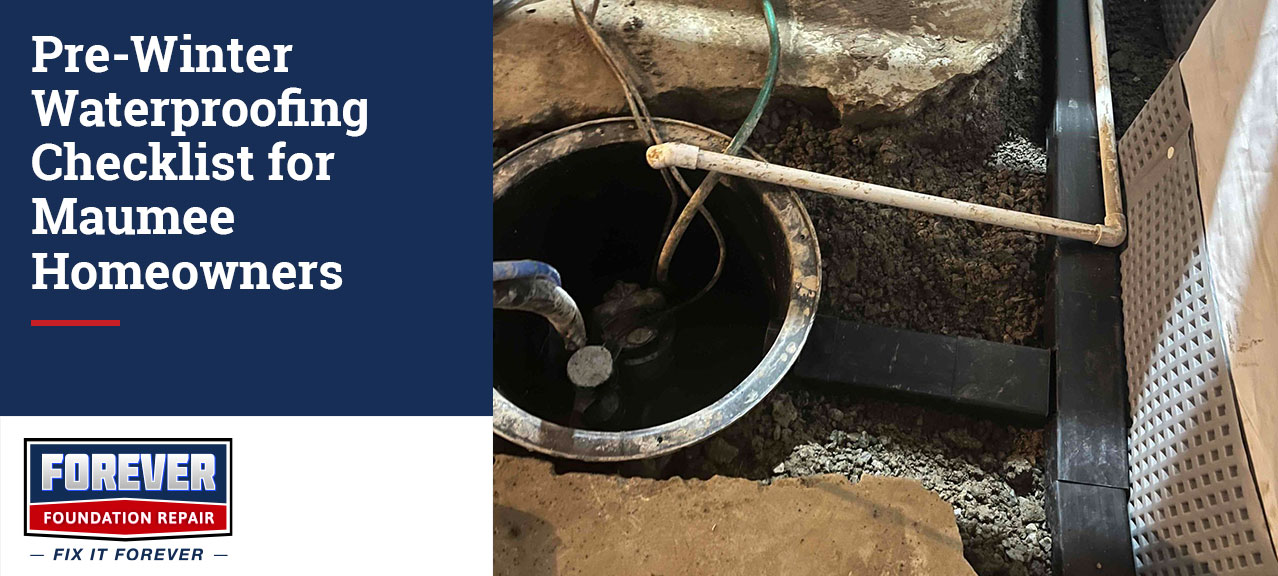
Pour water into the sump pit and confirm the pump cycles on, discharges outside, and shuts off properly. A battery backup sump pump matters most in winter, when power outages during storms hit at the same time as snowmelt and heavy precipitation—leaving your basement without protection at the worst possible moment.
3. Check Crawl Space Vapor Barriers: Look for Tears, Gaps, and Standing Water
Walk your crawl space and look for torn liner, open seams, or pooled water on the ground. Standing water needs to be resolved before any vapor barrier work, since a liner blocks evaporation but doesn’t remove water that’s already collecting on the floor. Crawl space encapsulation before winter keeps joists and insulation from absorbing moisture through the colder months.
4. Review Gutters and Downspout Extensions: Clear Debris and Route Water Away
Clear leaves and debris from gutters, then confirm downspout extensions carry water at least four to six feet from the foundation. A 1,000-square-foot roof sheds over 600 gallons of water from a single inch of rain, and all of it needs somewhere to go besides your foundation wall.
5. Check Yard Grading: Look for Water Pooling Near the Foundation After Rain
Walk the perimeter after a rain and note where water sits. Proper grading drops six inches within the first ten feet from your home. Anything flatter—or sloping toward the house—pushes water straight at the foundation.
6. Check Basement Moisture: Measure Humidity and Look for White Mineral Deposits
Use a hygrometer to check basement humidity, and watch for chalky white efflorescence on your walls. That residue signals water moving through concrete, and the pressure pushing it can reach 2,000 to 3,000 psi—enough to crack and spall masonry over time.
Why Pre-Winter Prep Matters in Maumee
Lucas County clay soil holds moisture long after a rainfall, and that’s where the trouble starts once temperatures drop. Freeze-thaw cycles break down the bonds holding soil particles together, reducing cohesion and shear strength with every cycle. Clay-heavy soils lose that strength faster than sandier ground—samples with high clay content showed strength loss rates near 29 percent after just ten freeze-thaw cycles, compared to roughly 18 percent for low-clay soil. Water locked inside that clay expands by close to nine percent as it freezes, pushing laterally against your foundation walls with enough repeated force to widen existing cracks or open new ones. Foundation crack sealing before the ground locks up for the season isn’t something to put off here.
How Maumee River Flood Risk and Groundwater Conditions Vary by Property
Not every Maumee home faces the same groundwater pressure. Snowmelt and seasonal rainfall recharge groundwater through late winter and spring, raising the water table during exactly the stretch when your foundation is most vulnerable. A home sitting closer to the Maumee River or a shallower water table will feel hydrostatic pressure sooner and harder than one on higher, better-drained ground. Your specific lot determines how much Maumee basement waterproofing your home actually needs.
Why Repairs Are Often Easier Before the Ground Freezes
Frozen ground doesn’t drain. Moisture from rain and melting snow lingers near your foundation longer, building hydrostatic pressure that pushes water through any crack it can find. Once the soil freezes solid, exterior excavation becomes far harder—and exposing an open foundation wall to sustained cold air mid-repair invites further damage. Getting ahead of this now, while the ground still cooperates, keeps the work simpler and the cost lower.
What Happens If You Skip Prep—and How to Get Help
Skipping these checks isn’t a gamble worth taking once Northwest Ohio winter arrives. Poor drainage saturates the soil around your foundation, and water always finds the path of least resistance—straight through any crack in your basement wall. Clogged gutters and downspouts make it worse, pushing water toward your foundation instead of away from it. A sump pump failure during a snowmelt event can turn a slow seep into a fully flooded basement within hours.
How Unresolved Cracks and Poor Drainage Can Lead to Winter Basement Flooding
A dry basement today doesn’t guarantee a dry basement in January. That’s the part Maumee homeowners often miss. Once hydrostatic pressure builds behind an unsealed crack, water finds its way through—regardless of how minor that opening looked back in October. Waiting costs more than acting now.
When Epoxy Sealing, Carbon-Fiber Reinforcement, or Crawl Space Repair May Be Needed
Some warning signs point well past a simple seal. Displacement across the crack face, width beyond 1/4 inch, horizontal cracking, stair-step patterns in block walls, or a wall that’s no longer plumb—these point toward structural repair, not surface patching. Carbon fiber reinforcement carries roughly 800,000 psi tensile strength, about ten times that of steel, stopping further widening while epoxy injection fills the void and restores a watertight seal. Standing water, musty odors, or sagging floors in your crawl space signal that encapsulation and drainage repair can’t wait.
What to Ask Forever Foundation Repair About Inspection Scope, Cost, and Local Experience
Before committing to foundation repair Maumee Ohio homeowners can trust, ask the right questions: years in the field, local soil experience, licensing and insurance, and warranty terms covering both labor and materials. Request references from nearby jobs—soil conditions can shift even a few miles apart—and confirm the crew has worked Lucas County clay before. A straightforward answer to each question tells you more than any sales pitch. Contact us today for a no obligation, custom inspection and repair quote.
FAQs About Pre-Winter Waterproofing in Maumee
When Should I Complete This Checklist Before Winter?
Mid-October is the target deadline. That window gives sealants and repairs enough time to cure before freezing temperatures arrive, and it keeps you ahead of the first major snowfall when scheduling gets tight and ground conditions start working against you.
Can Foundation Cracks Be Sealed in Cold Weather?
Yes. The soil around your basement walls typically holds near 52°F even when outdoor air drops well below freezing, so concrete stays warm enough for sealant to bond correctly. Cold weather also tends to stop active seepage, leaving cracks dry—a condition that often makes winter repairs more reliable than spring attempts when moisture is already present.
How Do Maumee Soil and Weather Affect Waterproofing Needs?
Maumee series soil is officially classified as poorly to very poorly drained, with hydraulic conductivity rated high to very high. Water moves fast through the ground but struggles to escape low-lying areas near your foundation. That combination is what drives so much of the region’s winter basement flooding trouble.
Do I Need a Battery Backup for My Sump Pump?
Yes. Weather-related power outages nearly doubled between 2014 and 2023 compared with the prior decade. An 84Ah battery backup runs roughly 68 hours during an outage, while a 120Ah unit stretches past 96 hours. When a snowmelt event hits and the power goes out, that runtime is the difference between a dry basement and a flooded one.
How Often Should I Repeat These Checks?
Inspect your systems at least twice yearly, with fall and spring as your primary focus. Run a quick basement check monthly through the winter months to catch any changes early.
Conclusion
Sealing cracks, testing your sump pump, clearing downspouts, and checking your crawl space now—before the ground freezes—keeps small problems from turning into costly winter repairs. Lucas County clay soil and Northwest Ohio’s freeze-thaw cycles don’t wait, and neither should you.
Forever Foundation Repair has served Maumee homeowners for over 15 years. That local experience with Lucas County soil and the Maumee River’s groundwater conditions means your inspection is handled by a team that knows exactly what to look for. Whether your needs are straightforward or structural, we’re here to help.
Contact us today for a no obligation, custom inspection and repair quote.